The geology behind our high levels
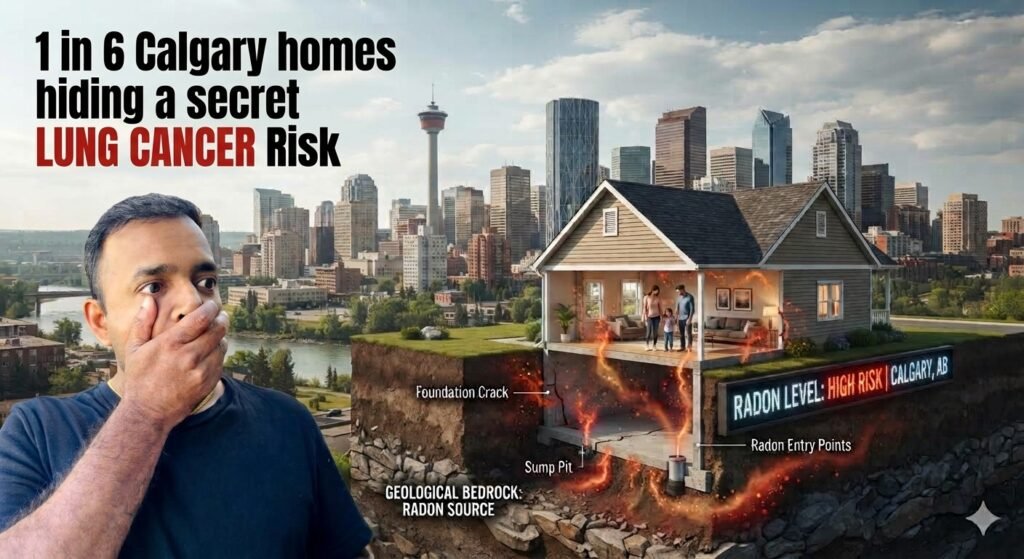
Over millions of years, the glaciers’ formation and retreat have caused large deposits of minerals and heavy metals in the Canadian Rockies and foothill areas. These accumulations are more concentrated in some areas. Unfortunately, Calgary and surrounding soil have trace amounts of Uranium enough to cause 1 in 6 homes to be dangerously high in radon.
Paired with modern building regulations leading to sealed, tight homes has made the situation even worse, especially during winter days.
Health Canada suggests 200 Bq/m3 as the threshold for radon mitigation; the world health suggest even 100Bq/m3 is dangerous. Even though different bodies have different standards, one thing is for certain: Any level of Radon is not healthy.
Common Myths
New Homes are safe
To be highly energy efficient, modern homes are designed to keep the conditioned air inside as much as possible, but this same quality makes them the best radon repository. Because of the stack effect, the home breathes in soil gas (which also contains radon gas) through the sub-slab. While other gases escape through exhausts, the radon gas sticks around as it’s the heaviest gas on earth.
My neighbor tested low, so I'm fine
Glacier deposits and soil pathways under the sub-slab of every house are different, resulting in varied soil gas chemistry.
Testing is expensive
Long-term cost as low as $50 at any local hardware store
The 3-step action plan
Step 1: Perform a long-term reading: An alpha-tracker-type radon detector provides the most cost-effective measurement. It is highly recommended to place this detector in the lowest dwelling place in your house for at least 3 months during the heating season. That is, sometime between Oct to April.
Step 2: If the average radon levels are above 200Bq/m3 then, call a reliable, C-NRPP-certified mitigator in your area. Make sure you check the official C-NRPP website to verify his certification and check his website for previous projects to see if he is the right fit.
Step 3: Conduct a short-term test, followed by a long-term test to determine if the mitigation work meets the scope of work.
Conclusion:
Isn’t it important to take responsibility for our family’s health instead of waiting for the government? Health Canada, WHO, and other agencies have already warned; now it’s in our hands to take action.
If you find us worthy of ensuring the air quality of your house meets Health Canada standards, then give us a call. Our C-NRPP-certified technician will be pleased to help.